Best evidence · Patient guide
Sciatica from a slipped disc
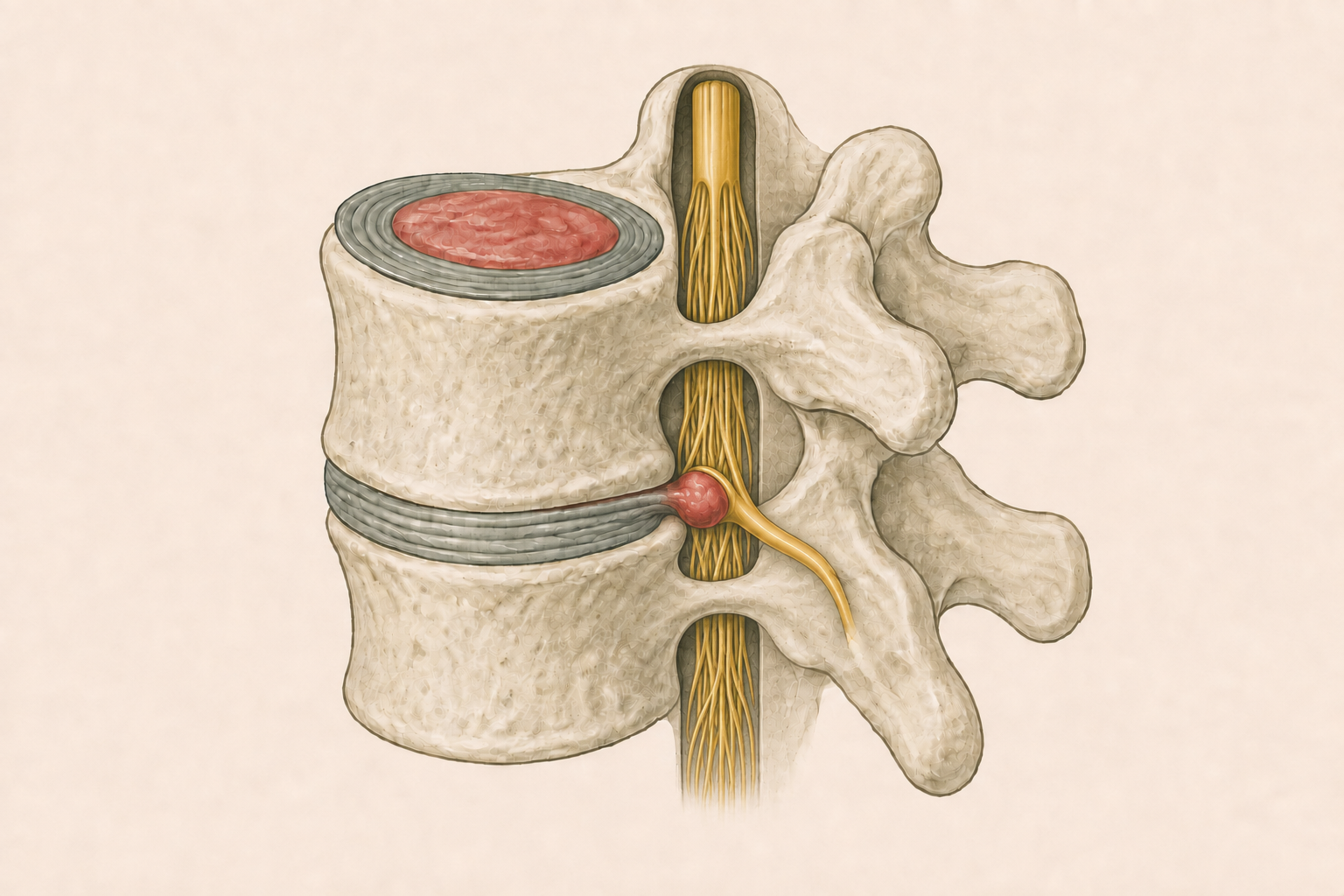
A slipped disc is a common cause of sciatica. The name is slightly misleading: the whole disc does not slip out of place. Instead, part of its soft centre pushes through the tougher outer layer and may irritate a nearby nerve.
Seek urgent medical help if you develop new difficulty passing or controlling urine, loss of bowel control, numbness around the genitals or bottom, or leg weakness that is getting worse quickly. These can be signs of a rare but serious nerve problem called cauda equina syndrome.
What is a lumbar disc prolapse?
The bones of the lower back are called vertebrae. Between them sit discs, which act as cushions. Each disc has a soft centre held inside a tougher outer ring. A disc prolapse—or herniated disc—happens when some of the centre pushes through the outer layer.
MRI reports may use words such as bulge, protrusion, extrusion or sequestration. These describe how the disc looks, not how much pain it must cause. A large prolapse can settle without surgery, while a smaller one can be troublesome if it lies very close to a nerve.
How can it cause sciatica?
The protruding disc may press on a nerve leaving the lower spine. Disc material can also irritate and inflame the nerve even when pressure is not severe. This is why the size of a prolapse does not always match the amount of pain.
Symptoms may include pain travelling into the leg, tingling, numbness or weakness. The exact area depends partly on which nerve is affected. L5 and S1 are the nerves most commonly involved, although symptoms do not always follow a textbook pattern.
What does the MRI report mean?
An MRI shows where the prolapse is, which side it is on and whether it touches or presses on a nerve. The key question is whether the scan finding matches the person’s pain and examination.
Disc wear and bulging are common even in people who have no pain. A scan finding should not automatically become the diagnosis or lead to an injection or operation. Read more about when MRI is useful for sciatica.
Can a prolapsed disc shrink?
Yes. The body can gradually break down and absorb protruding disc material. This appears to happen more often when a piece of disc has pushed fully through the outer layer.
Shrinkage is not guaranteed, but many people improve without an operation. Symptoms can settle even if a repeat scan would still show some disc change, so another MRI is not routinely needed simply to prove recovery.
How is disc-related sciatica treated?
Early treatment usually includes a clear explanation, keeping active as much as symptoms allow and a rehabilitation plan suited to the individual. Medicines need a discussion of benefits and possible harms; some commonly prescribed medicines have not been shown to help sciatica overall.
For selected people with recent, severe sciatica, an epidural or nerve-root injection may be considered. A surgical opinion may help when other non-surgical care has not improved pain or everyday function and the scan matches the symptoms.
When might specialist assessment help?
A specialist assessment brings together the pattern of pain, any numbness or weakness, the examination, the scan and the effect on everyday life. The aim is to explain what is most likely happening and discuss sensible next steps.
Return to the main sciatica guide or read about Dr Oliver Seyfried’s practice and experience.
Common questions
Is a bulging disc the same as a slipped disc?
The words are often used loosely. They describe different amounts and shapes of disc movement. None of them proves that the disc is causing pain; the scan must match the symptoms and examination.
Does a large disc prolapse always need surgery?
No. Size is only one part of the picture. Pain, numbness or weakness, the position of the prolapse, progress over time and the person’s priorities all matter. Disc material may also shrink naturally.
Can a disc prolapse cause back pain without sciatica?
Yes. Disc changes may be linked with back pain, leg pain, both or neither. Sciatica specifically means pain travelling into the leg because a nerve leaving the lower spine is irritated.
Will lifting make the disc move further?
Not necessarily. Advice should be individual, but long periods of avoiding movement can slow recovery. A gradual return to activity is usually more helpful than assuming that every painful movement is causing damage.
Evidence used
- NICE guideline NG59: assessment and management of low-back pain and sciatica.
- Jensen RK et al. Diagnosis and treatment of sciatica. BMJ. 2019;367:l6273.
- Zou T et al. Incidence of spontaneous resorption of lumbar disc herniation: a meta-analysis. Clin Spine Surg. 2024.
Written and clinically reviewed by Dr Oliver Seyfried · Published and last reviewed 27 August 2026