Best evidence · Patient guide
Which nerve is causing sciatica? L1 to S1 patterns
The nerves in the lower back are given names from L1 to L5 and S1. L5 and S1 are the two most often linked with sciatica from a slipped disc. Where you feel pain or numbness may offer a clue, but symptoms do not always follow a neat pattern.
Seek urgent medical help if you develop new problems controlling your bladder or bowels, numbness around the genitals or bottom, or rapidly worsening leg weakness.
What do L1 to S1 mean?
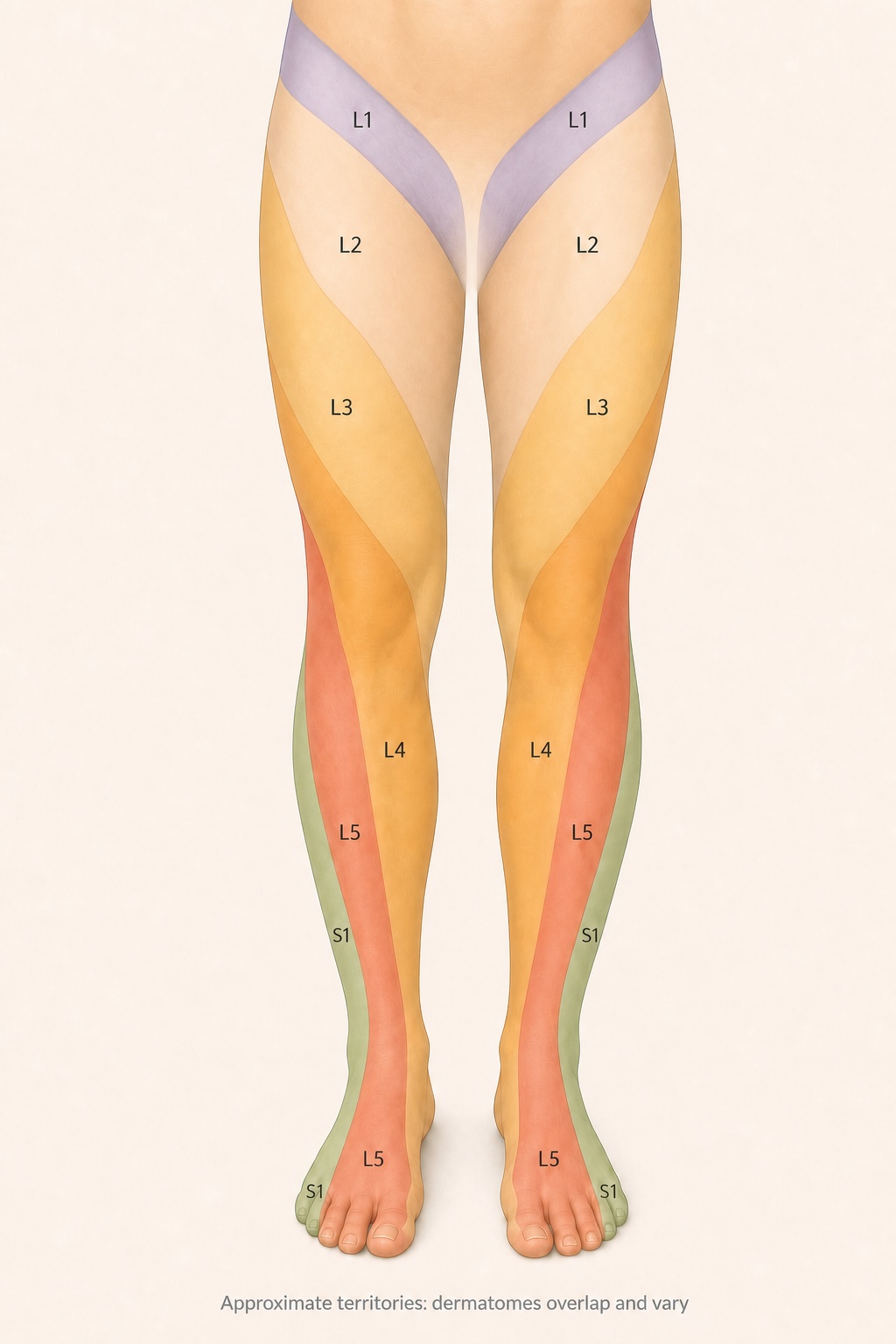
These are simply the names given to nerves leaving the lower part of the spine. Each nerve helps with feeling and movement in certain parts of the leg, although neighbouring nerves share some of the same areas.
A slipped disc usually irritates the nerve passing behind it. This is why the number given to a disc on an MRI scan may not match the number of the affected nerve.
Can the upper nerves be affected?
Yes, although L1, L2, L3 and L4 problems are less common than L5 or S1 sciatica. Pain from these upper nerves is more likely to be felt in the groin, the front of the thigh, around the knee or along the inner lower leg. Some people also notice weakness when lifting the thigh or straightening the knee.
Hip and other leg problems can cause similar symptoms. The pain location alone is therefore not enough to recommend an injection or operation; it needs to be considered alongside an examination and, when useful, a scan.
What might L5 sciatica feel like?
L5 pain may travel through the buttock and down the outside of the leg towards the top of the foot or big toe. There may also be tingling or numbness.
If the nerve is affecting muscle strength, lifting the foot or big toe may feel harder. Walking on your heels may also be difficult. These findings can be useful clues, but none proves an L5 problem by itself.
What might S1 sciatica feel like?
S1 pain may travel through the buttock and down the back or outside of the leg towards the outer edge or sole of the foot. Tingling or numbness may follow a similar route.
Some people find it harder to push the foot down, stand on tiptoe or repeatedly raise the heel. The ankle reflex may also change, although reflexes naturally vary between people.
Why does my pain not match the diagram?
This is very common. The areas supplied by L5 and S1 overlap, and inflammation around a nerve can make pain spread beyond the expected route. Research has shown that even experienced clinicians cannot reliably name the affected nerve from a pain drawing alone.
The coloured areas are sometimes called dermatomes. They are helpful teaching maps, not a test or a set of fixed borders.
How do we work out which nerve is involved?
The consultation brings several clues together: where the symptoms travel, changes in feeling, muscle strength, reflexes and movements that stretch the nerves. No single part of this assessment gives the whole answer.
An MRI scan may then show whether a slipped disc or narrowing in the spine matches the symptoms and examination. This is particularly important before considering a targeted nerve-root injection or referral to a spinal surgeon.
A specialist assessment
Dr Seyfried looks at the overall pattern rather than relying on a symptom map or scan report alone. He also considers hip, joint and peripheral nerve problems that can sometimes resemble sciatica.
You can also read the main patient guide to sciatica or learn more about Dr Oliver Seyfried.
Common questions
Can pain from the L1, L2 or L3 nerves be treated?
Yes. Treatment depends on finding the likely cause. It may include medication, physiotherapy or other rehabilitation, and occasionally a targeted injection or surgical opinion.
Does pain in the big toe always mean L5?
No. It is one clue, but L5 and neighbouring nerve patterns overlap. The rest of the symptoms, examination and any relevant scan also matter.
Does pain in the little toe always mean S1?
No. S1 can cause symptoms around the outside of the foot, but other nerves and conditions can affect this area too.
What is foot drop?
Foot drop means weakness when lifting the front of the foot. It can happen when the L5 nerve is affected, but there are other possible causes. New foot drop should be assessed promptly.
Can more than one nerve be affected?
Yes. A large slipped disc or narrowing at more than one level can affect several nerves, so symptoms may not fit neatly into an L5 or S1 pattern.
Evidence used
- Albert HB et al. Pain patterns in MRI-confirmed single-level radiculopathy: a diagnostic accuracy study. Chiropr Man Therap. 2019.
- Taylor CS et al. Do L5 and S1 nerve-root compressions produce radicular pain in a dermatomal pattern? Spine. 2013.
- Lumbar radicular pain: anatomy, clinical findings and management. BJA Education. 2022.
- Jensen RK et al. Diagnosis and treatment of sciatica. BMJ. 2019;367:l6273.
Written and clinically reviewed by Dr Oliver Seyfried · Published and last reviewed 27 August 2026