Best evidence · Patient guide
Hoffa’s fat pad pain of the knee
Hoffa’s fat pad is a soft, sensitive structure at the front of the knee. It can become painful when it is repeatedly pinched, irritated after an injury or affected by scarring. An MRI can help, but the scan alone cannot make the diagnosis.
What is Hoffa’s fat pad?
The fat pad fills part of the space behind the tendon below the kneecap. It contains many nerve endings and blood vessels, and changes shape whenever the knee bends or straightens.
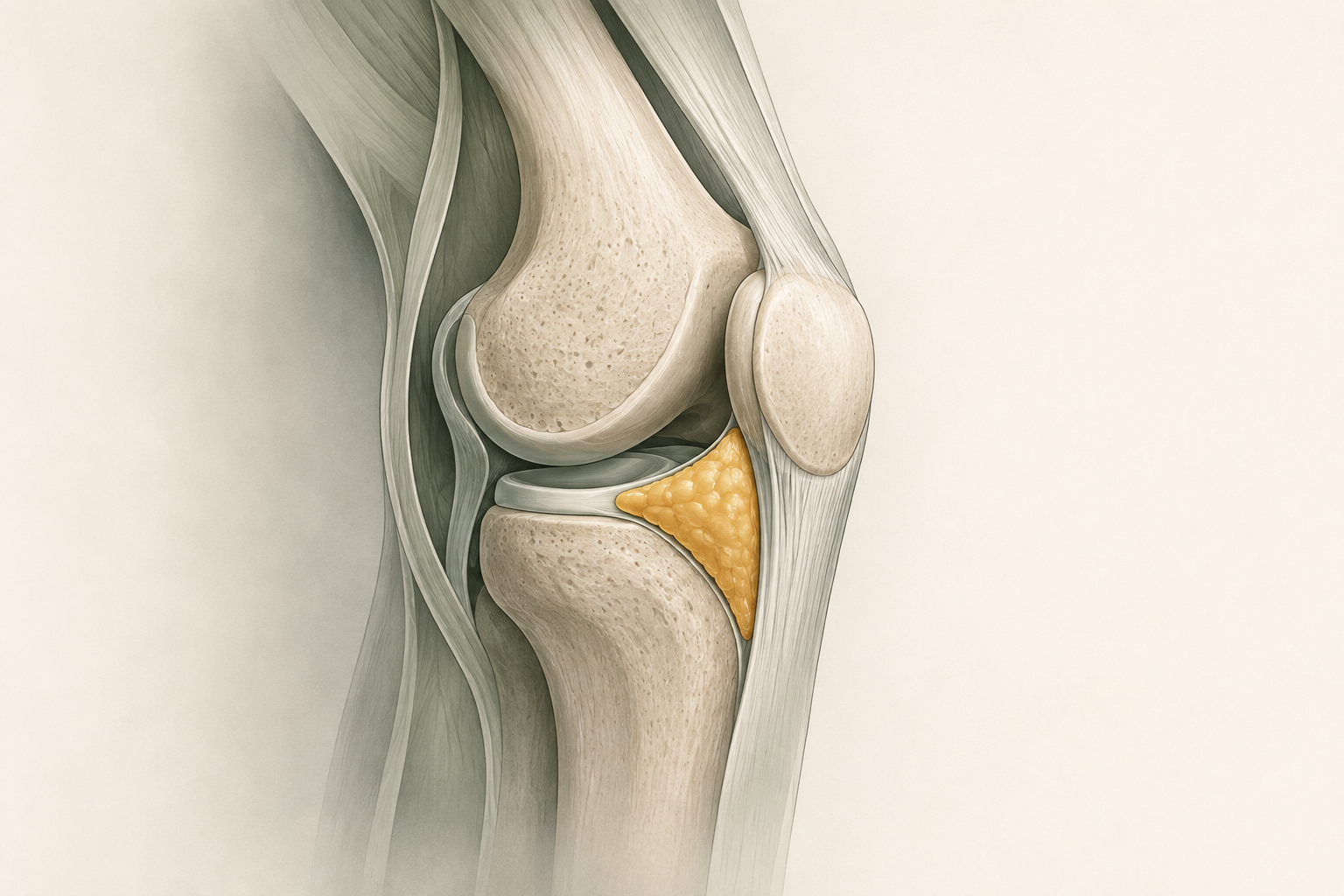
An injury, repeated pinching, the way the kneecap moves or scarring after surgery can all irritate it.
What does it usually feel like?
Pain is usually felt at the front of the knee, often on either side of the tendon below the kneecap. It may be worse when standing with the knee locked backwards, fully straightening the knee, running, jumping, kicking, using stairs or staying on the leg for a long time. The area may feel tender or slightly full.
Could it be something else?
Several knee problems can feel similar. These include pain from the kneecap joint, irritated tendons, a meniscal problem, arthritis or a small fold of tissue inside the knee called a plica. Pain can also occasionally come from outside the knee. After an operation, stiffness and internal scarring may be important. The assessment looks at whether the fat pad is the main problem or only one part of it.
Assessment and scans
The assessment looks at exactly where the pain is felt, which movements bring it on, whether the knee locks backwards, how the kneecap moves, and the strength and control of the whole leg. An X-ray may help if arthritis, alignment or a bone problem is suspected. Ultrasound can show some of the structures near the front of the knee.
MRI gives the clearest view of the fat pad and may show swelling, scarring or another problem. However, these changes are not always painful. The scan needs to match the symptoms and examination.
What treatment may help?
Treatment does not usually involve an operation. It works best with a specialist physiotherapist who understands fat-pad pain. For a time, it may help to reduce activities that repeatedly pinch the fat pad and to avoid standing with the knee locked backwards. Taping can sometimes reduce irritation. Movement, walking technique and strength are then rebuilt slowly. The aim is gradual progress, not complete rest.
Medication may help settle pain enough to take part in rehabilitation. The choice depends on other health conditions and current medicines. It may include ordinary pain relief, anti-inflammatory treatment when suitable, or medicines used when the nervous system has become unusually sensitive. Gentle, repeated touch or other topical desensitisation can also help when the front of the knee has become very sensitive.
Close, consistent work with the physiotherapist is important because improvement can be extremely slow. Hoffa’s fat-pad pain is often diagnosed late, after the knee has remained irritated for a long time. Recovery may need to be measured over months rather than days or weeks.
When might a surgical opinion help?
Most people do not need an operation. A discussion with a specialist knee surgeon may be helpful if a scan shows a lump or a clear physical problem, there is a great deal of scarring after previous surgery, the diagnosis remains uncertain, or severe symptoms continue despite a long period of specialist rehabilitation. Keyhole surgery to remove part of the painful tissue or treat another knee problem may help a carefully selected person, although the research evidence is limited. Preserving as much normal fat pad as possible is generally considered beneficial.
Common questions
Where is Hoffa’s fat pad?
It is a soft pad of tissue behind the tendon below the kneecap. It contains many nerve endings and can be very painful when it becomes irritated or repeatedly pinched.
Does swelling on an MRI prove the diagnosis?
No. MRI may show swelling or scarring, but similar changes can appear in people whose pain comes from somewhere else. The scan must fit with the symptoms and examination.
Why can recovery take so long?
The fat pad is sensitive and is repeatedly loaded during ordinary standing and walking. Symptoms are also often recognised late. Improvement can therefore be extremely slow and usually depends on steady, carefully paced rehabilitation rather than repeatedly testing the painful movement.
Evidence used
- Verrier J et al. Diagnosis and treatment of infrapatellar fat pad disorders: a systematic mapping review. PM&R. 2026;18:547–561.
- Hannon J et al. Evaluation, treatment, and rehabilitation implications of the infrapatellar fat pad. Sports Health. 2016;8:167–171.
- Rooney A et al. The surgical treatment of anterior knee pain due to infrapatellar fat pad pathology: a systematic review. Orthop Traumatol Surg Res. 2015;101:469–475.
- White L et al. Predisposing factors for Hoffa’s fat pad syndrome: a systematic review. J Exp Orthop. 2023;10:48.
Written and clinically reviewed by Dr Oliver Seyfried · Published and last reviewed 3 September 2026